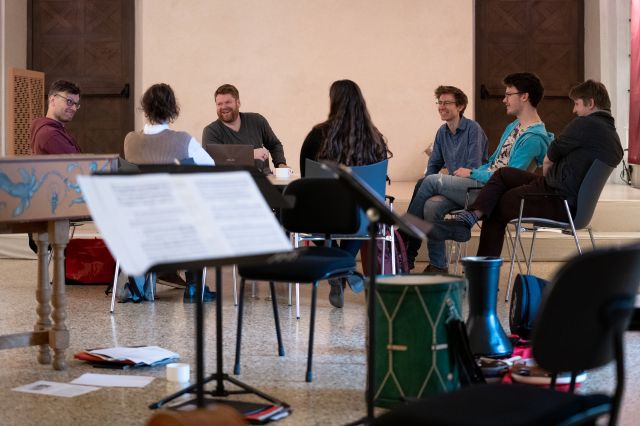
Une résidence de recherche timbréeJournées de réflexion autour du timbre musical
>>
Research
Ambronay Research offers multi-disciplinary meetings between intellectuals and performing artists around its theme of 'music and the sacred'. It is underpinned by a scientific committee which brings together researchers from various disciplines within the human sciences, united by their interest in music. Bruno Gelas (linguist), Marianne Massin (philosopher), Sylvie Pébrier (musicologist), Aline Tauzin (anthropologist) and Sophie Wahnich (historian).
- Transe, ravissement, Extase
Le nouveau Cahier d'Ambronay a pour objet l'expérience bouleversante qu'est l'émotion musicale et en analyse les manifestations les plus intenses.

L'émotion musicale constitue une expérience paradoxale pouvant prendre de multiples formes et induire des modalités exacerbées d'altération de la conscience de soi. Ce recueil étudie cette expérience et se focalise sur ses manifestations les plus intenses : les états de transe, de ravissement et d'extase.
Dans ces modalités qui constituent une brèche parfois violente dans le temps quotidien, s'éprouve un transport lié à la musique et aux rituels. Les frontières et les identités paraissent se dissoudre dans l'émotion musicale qui emporte le sujet au-delà de lui et le transcende. Dans ce vertige, le seuil qui sépare profane et sacré peut sembler s'abolir.Fruit d'un travail de recherche initié au Centre culturel de rencontre d'Ambronay sous la forme de séminaires, cet ouvrage présente la dynamique d'une investigation commune. La confrontation de textes de personnalités d'horizons divers (anthropologues, musicologues, philosophe, metteur en scène et écrivain) permet de préciser les notions de transe, de ravissement et d'extase. Elle permet aussi de prêter attention aux contextes socio-culturels ou historiques de ces expériences afin de ne pas les confondre hâtivement. Elle invite enfin à un cheminement libre dans ces notions pour poursuivre le dialogue qui s'instaure en filigrane dans les textes rassemblés.
Textes de :
Aline Tauzin, anthropologue CNRS/Université de Picardie
L'émotion musicale dans la civilisation arabo-musulmaneMarion Aubrée, anthropologue CRBC/CEIFR - EHESS
La transe : de la musique et de la voixMarianne Massin, philosophe Université de Lille 3/ UMR 8163
La grâce fragile du ravissement musicalSylvie Pébrier, musicologue
Écoute et ravissement dans quelques scènes d'opéra baroquePierre Kuentz, auteur et metteur en scène
Dramaturgie de la boucheViolaine Anger, musicologue Université d'Évry-Val-d'Essone
Le plaisir musical suprême au xixe siècle, quelques pistesBruno Moysan, musicologue IEP et CNSMD de Paris
La virtuosité romantique de Liszt comme expérience de la transe, du ravissement et de l'extase
Textes réunis par Marianne Massin.
- The research actors

The scientific committee
It is the responsibility of the scientific committee to define the parameters of research, and to oversee the fulfilling of Ambronay's double mission of the conservation of a precious cultural heritage and the dissemination of knowledge pertaining to it.
It therefore comes down to the committee to reflect on the potential activities which might be undertaken by the Cultural Encounter Centre in relation to its theme of music and the sacred, and to bring together the historical and ontological aspects of the Abbey in an approach which is at once both historical and contemporary.
The board of experts
This group unites experts in the field of research, music and the arts on specific topics, and their regular meetings give rise to the publication of journals and the development of varied and fruitful discussion and thought.
The writers and the publications
Within the framework of the Cultural Encounter Centre project, Ambronay has initiated a publishing activity. Through already published works and those in production or at the planning stage, the research and discussion activity is dynamic and ongoing. The authors are often members of the scientific committee or the board of experts, but equally may have no formal links with the Cultural Encounter Centre.
Members of the scientific committee
- Bruno Gelas, former president of the university Lyon II, director of the doctoral school of 'Letters, languages, linguistics and arts', and also a member of the scientific advisory board of Cadir (Centre pour l'Analyse du Discours Religieux). A linguist, he co-directed the works Deleuze et les écrivains (Cécile Defaut, 2007) and Ecrire après Auschwitz. Mémoires croisées France-Allemagne (P.U. Lyon, 2006).
- Marianne Massin, graduate of the Ecole Normale Supérieure, and a holder of a Doctorate in philosophy, is Maître de Conférences in aesthetics and philosophy of art at the university Lille 3. Her thesis, Les Figures du ravissement. Enjeux philosophiques et esthétiques, won the prize 'Le Monde de la recherche universitaire' and was published in 2001. She is particularly interested in the question of inspiration at the junction of philosophy and the arts, and in 2007 published La Pensée vive. Essai sur l'inspiration philosophique. Marianne Massin has been part of the Ambronay scientific committee since 2008.
- Sylvie Pébrier is a musicology graduate of the Paris Conservatoire, and also studied at the Institut d'Etudes Politiques in Paris. An inspector of music for the French ministry of culture, she is currently on secondment to run a project to construct a centre dedicated to early music. A member of Rémy Stricker's seminar on interpretation, she also teaches at the Paris Conservatoire and at Tours University.
- Aline Tauzin, ethnologist and researcher at the CNRS (National Centre for Scientific Research) in the psychoanalysis and social practices laboratory. Specialising in Islamic societies, she has explored the concepts of the body and of musicality. Author of Figures du féminin dans la société maure, Aline Tauzin was scientific director of the symposium 'Musique, femme et interdits', which ran in conjunction with the 2008 Ambronay Festival. She produced for the publishers Karthala in 2008 Insultes, injures et vanne – En France et au Maghreb.
The honorary members
- Raymond Court, emeritus professor of the Jean Moulin philosophy faculty, he also taught musicology at the University Lyon-III. His published works include Le musical: essai sur les fondements anthropologiques de l'art, Adorno et la nouvelle musique, Sagesse de l'art, Force et dérive des principes and Le voir et la voix (essai sur les voies esthétiques).
- Jean-Yves Hameline, musicologist and Doctor of Theology, has taught in Western catholic institutions and at the Insitut catholique in Paris, his subjects being the anthropology and historical sociology of worship and rites and the musicology of the Christian religion. His published works include Une poétique du rituel.
- Contact

Votre demande
Vous recevez ce mail en copie car vous venez d'effectuer une demande sur notre site internet, en copie ci-dessous.
- The fields of research

Hymns
This research field has developed as a result of reflection on the hundred years since the separation of the Church from the State; it encompasses the themes of the sacred, the collective, the religious, of articulation at an ideological level. A comparison with the practices of other nations is also possible. It is a topic to be explored in the medium rather than the short term.
The voice and the sacred in the baroque era
One of the themes of the founding symposium, this research topic may be practically applied to the Centre's activities. A particular resonance was found in 2005 with the theme of the castrati, coinciding with the 300th anniversary of the birth of Farinelli. Not that it is always necessary to fall in with current commemorative trends, but this particular voice exercised a grip on the collective imagination which can be felt even to this day. Why is this such a fashionable subject? We can partly associate it with the thinking on flamenco, where the more the voice is imbued with history, the more beautiful it is.
The representation of the tragic
With a masterclass on the Leçons de ténèbres, it seemed interesting to compare the baroque and contemporary representations of the tragic. What does the enjoyment of music and the enjoyment of violence mean? This can also be a means of reflecting upon the ambivalent nature of music as much as of the sacred.
- The aims

In its function as a Cultural Encounter Centre, Ambronay offers to researchers the possibility of setting their research and methodologies side-by-side with the realities of practical music-making – and vice versa.
Research at Ambronay is therefore undertaken so that the arts and their audiences, professionals and amateurs, are not in opposition but can instead meet in an atmosphere of exchange and fruitful debate.
Crossing academic boundaries
The work undertaken at Ambronay is enhanced by a partnership of several different academic disciplines around a single issue; human sciences and musicology, musicologists and musicians, musicians and artists etc… A meeting which is as much intellectual as artistic.
A meeting place
In order to get to grips with the complexity of reality, it is necessary to deconstruct an issue in order to then approach it from a different perspective, to bring together historical time and geographical space in order to break down old habits and prejudices. In the same way, there will inevitably be a meeting of differing national practices as researchers and artists from all over the world bring their own complementary approaches to the debate.
Flexibility
A variety of work processes and scales of production are put into place to respond flexibly to the needs of any particular project. Following discussion and reflection, it is possible to formulate approaches which are in harmony with the specific focus of the subject. Study days or seminars may open up wider forums of debate; it may even be that a subject inspires a desire to render it, in collaboration with artists or musicians, in an artistic form.
Observe our activities
One of our main objectives at Ambronay is to include the wider public in our vast range of activities. To make this possible, the public may be invited to study days, symposiums and performances. To preserve Ambronay's capacity for adaptiveness and responsiveness, an experimental space has been specially created for this at Ambronay.
- The publications and reports

Published books
Musique et sacré,
Ercole Amante, Hercule Amoureux, Collectif
L'Emotion improbable, Laurent Denizeau
Le Carnaval et la Folie, Collectif
Musique, théologie et sacré, d'Oresme à Erasme ; Collectif, dirigé par Annie Coeurdevey et Philippe Vendrix
Forthcoming books
L'Abbaye d'Ambronay, Béatrice Méténier
Leçons de Ténèbres, Jean-Yves Hameline
Femmes, Musique et Interdits, CollectifIl diluvio universale-Michelangelo Falvetti, Collectif, Cahiers d'Ambronay
The book shop